So we already had $2T in unease, now add another $600B to that. 2.6T for 140M taxpayers is $18,500 per taxpayer… assuming we ever pay it back. Will we?

What happens with QE is that the government issues bonds and then the fed “makes” this money out of thin air and buys the bonds. The government gets the money and the fed holds the bonds. The feds balance sheet is in check. In an honest and just world, the government would pay the bondholder back at the end of the bonds life, but maybe not in this world… I am thinking somewhere down the road the fed is going to say, no problem, we will just reissue this for you or just continue to hold it or “who cares?”. So in this world, it really doesn’t matter if it ever gets repaid…

The real way this gets paid though is by inflation. They just steal if fom you. Bernanke comes right out and says that they want to have inflation. Don’t you keep about $50 or so in your wallet? You know, spending money. Well that invisible hand of inflation at 2.0%/yr is stealing $1.00 from your pocket and you don’t even realize it. And that target is a MINIMUM of 2%, so 2% is not really a target at all in that sense. With a target, you are sometimes higher, sometimes lower. This is 2% or more. What they are saying is we will steal at least a $1, maybe more but not less than that, from your pocket change. Maybe that is the change I voted for.

You should be outraged. I explain below just why, but I also want to tell you what you can do about it. And you can do something about it, but we all have to act together!

In 2000 the Consumer Price Index was 172.2.
Today (October, 2010) it is 218.711.

Why they feel the need to now measure it out to the thousandths is so f-ing funny, but that is not what this post is about.

219/172 is 27%. So the crap you are buying (just to have a life) is now costing you 27% more than it did 10 years ago. This is theft. The money in your savings is now worth 27% less. It is just gone, missing, kaput, stolen. And the Fed (the one who stole it and gave it to the banks and the fatcats working there) is afraid of deflation. On the other hand, me and you, the people, the not-so-fat-cats, we would love it… we would be quite happy if instead of 27% missing from our savings, we could have 27% more. We could buy 27% more for our money. I don’t even want MORE, I would be happy with just the SAME purchasing power as I had 10 years ago. That would only be good for the people. It is good for the people. The people, don’t care about the banks. So the Fed, who is arguably the most power organization on the planet, clearly is not in this for the people.

The Fed (wait, why am I using a capital, they are getting a small “f” from now on) is afraid of deflation and “the Bernanke” is now saying we need a $600 B quantitative easing. Thanks for stealing me from me Mr. Bernanke. I mean, in the grand scheme of things, are we having any deflation? Hell no, that 27% above is real inflation data from the last 10 years. We aren’t even close!! We are 27% away from them not stealing from us. Even if we deflated 10% a year for the next two years, they still stole 3% from us.

Now, the fed doesn’t count food and energy, you might say, and I have used “All items” when obtaining the CPI, they only measure “core inflation”. Huh, well, the last I checked, I do consume food and energy and all that other stuff, so I am counting it. And I assume food should have gotten cheaper over the last 10 years because we have had advances in science and farming (we call this learning), but alas, the people are not benefiting from these advances via cheaper food. No, we can’t even afford good organic food any more, but that is another post.

The fed doesn’t include housing and maybe that is where we are seeing this awful deflation. By the same logic, I do live in a house, so I count that too. And anyways, is it that bad if housing prices get cheaper for a few years? Doesn’t that make it more affordable for that young couple to buy their first house? I’m not selling mine anyway and I have owned it for 10 years, so it is still worth more than what I paid for it! If it goes down in value, I pay less in property taxes. Hallelujah? Lower taxes and I’ve been jacked to the tune or 50% + on those anyway, see below!

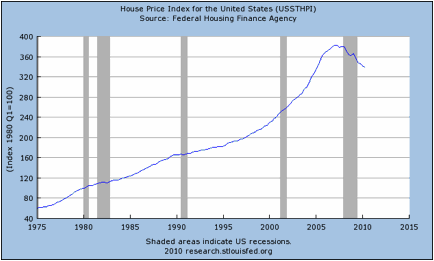
Oh, you say, “Well, it is just terrible for those who bought just 2 or 3 years ago.” Maybe, but not quite? For most of those who bought 3 years ago, they weren’t buying their first house. No they sold an inflated house to buy that new inflated house, and out of all homeowners, regardless of when they got their latest mortgage, they have mostly been living in a house for a lot longer than 3 years. Houses that are 50 years old still have people living in them don’t they? But, in this argument, I will go with only 10 years. That is recent enough. Blink and 10 years go by anyway. Well, looking at the latest 10 years, housing prices since 2000 are up from 220 to 340, or about 50% + property taxes. Housing prices could deflate quite some ways (50% from today’s prices) and it would just make it cheaper for new buyers, with no real loss, no true loss, to homeowners. (I am going envelope here, but this comes from the chart below.)

So why is deflation bad? The answer is “Deflation is not bad for the people”. Deflation is good for the people. Bring it! Your wages will not drop. You get paid the same and you can buy more with your money. Suddenly it makes sense to be a saver!! Wow, go figure?

Deflation is only bad for the BIG banks and for a HUGE debtor, who wants to pay his debts off with a lower valued dollar. Uncle Sam? But currently, it is all about the banks. If those people who bought houses in the last 3 years all see their housing value go down they become underwater (bad loan by the banks) and they might default more often than was planned for. This would show how insolvent these large banks are… so instead of letting this happen to their friends, the fed will steal from you and I (the people) by ramping up inflation and making us pay. And stealing it is! Not only that, but I have to burden myself with future taxes to pay back their $600 Billion.

This is what you can do and I hope you do it. I would be perfectly happy to see the big banks all go away and just keep my money at my local credit union. You should all do that. Go out now and close your bank account at Wells Fargo, Citibank, JP Morgan Chase, wherever it is in those large crappy banks. Get it out now!! Get your money out of that bank and put it into a local credit union.

Thank you for reading these thoughts, if you care.

Please comment.

OK, so I learned something this past weekend.  I was fishing down in the Rockport area and on Saturday I missed several fish…  Below is what I learned. 

First though a little background info.  I wade fish.  I use artificials.  The stuff below does not apply to bait fisherman, as it is for the more sophisticated, the affluent, the proud, the wade fisherman, the artificial lure man, he who scoffs at the bait fisherman!! 

To be an artificial lure man, you need to get wet, you need to get in with the fish.  You stalk fish.  You use a jig and a plastic, maybe a top water, but the top water is situational, whereas the jig and plastic is the go to lure.  Also, some plastic baits are better than others, I like Bass Assassins, Texas Salt Water Assassins, Paul Browns, anything plastic in the 4 to 5 inch size, but more on that below. 

Also, the first 5 items in this list are all things I have learned in the past and already know.  The very last one, that is what I learned this weekend.

1.  You need to be able to cast the farthest and you will catch more fish.  This is a simple numbers thing.  While you also need to be accurate, it is a probability problem, a statistical fact, that if your lure is in the bite zone longer, you will get more strikes.  The bite zone is really on the line (the weed line or whatever you are fishing) and short casts don’t work as well, because you are spending more time casting and less time in the water and on top of that, the closest 10 yards (to the fisherman) produce fewer strikes, because the fish get spooked when they get that close to you.  So if you cast 20 yards you are 50% in the zone, if you cast 30 you are 66% in the zone, 40 and you are 75% in the zone.  I think you get the picture.  Even fisherman need to use math.

2.  You need to watch for fish and for signs of fish in water.  This is as important as being able to cast far, even more so.  In this case, you look for slicks, birds, and flashes of orange/red in the water in your vicinity.   Also, look for bait fish.  If you see baitfish exploding and there are no birds, then there is a fish there.  Fish where the bait is.  If you actually see the fish, you won’t need to cast far, just beyond their nose (say 2-3 yards) and then drag it in front of their nose.   This is where it takes some skill with a spinning reel, but is a bit easier with a casting reel.  Another tradeoff in fishing… as it is much easier to control placement with a casting reel.

3.  Walk the weedlines and edges, but don’t ignore the shallows.  On a cold fall morning, the sun will warm the shallows and the reds will get right up there in 8 to 12 inches of water, where you can sightfish for them.  This is very effective.

4.  Use the right equipment.  a)  Use braid.  You can cast farther and it is stronger.  It costs more up front, but it lasts a lot longer.  b) Use a spinning real or a casting reel depending on your skills and on the situation.  The spinning reel offers superior distance.  With braid and a spinning reel, even as an amateur, you will be able to cast as far as a fishing guide.   If you need highly accurate casts and can sacrifice some distance, say in the shallows, then go with the casting reel.  The ideal situation would be to fish with a spinning rod/reel/braid combo and have an extra casting rod/reel in your wade belt.

5.  Big reds, little reds, no matter, they are both dumb and slow.  They are not really great at hitting a darting lure.  Put it right in front of them and you can watch them miss it.  Don’t fish to fast.  It is best if your lure swims a bit, if it rises and falls a bit more slowly.  (Not for trout though, we are talking reds here.)  Now, there is some drawback to the paddle tail or curly tail plastic, because the tail creates some extra wind resistance (drag) and you will not be able to throw it as far.  When after reds though, the slow-moving bait will allow them to be more accurate in hitting your lure.  It is not that you miss them, but more that they miss you.  Fish the slower falling lure and hook up with more fish.

6.  OK, this is what I learned.   If your lure is too long, you will miss more fish, so use a shorter lure.   Specifically, do not let the tail get too far from your jighead/hook.  I know, I know, based on 5 above, which I already knew, you would think I would know better.  I think I got caught up when the guide said that Reds like to feed on eels…  Anyway, Reds are not good at feeding.  They miss the lure, ALOT.  I sometimes wonder how they can survive when they have to chase actual baitfish.     It took me an afternoon of missing my hits as my friends hooked up, before I realized that the extra long swim bait that (our guide) gave me was the problem.  In his defense, he did say to use the shorter bait when we went for reds, but I did not switch.  Anyway, I missed several fish.  They hit, I had my hits, maybe even more, but I felt them hit the tail and not get hooked up.  The short jighead I had was way up in the front of about a 6 to 7 inch monstrosity of a paddle tail.  I gather that if I had a shorter plastic, I would have hooked up on 75% of those bites.  As it was, I just missed too many fish.  No problem.  I will it right next time!
Tax breaks cost money?

Posted: October 27, 2010 in taxes

 So now tax breaks “COST” the government?  What does it cost?  Do they use our tax dollars to pay for it?  

 From the WSJ.com:

Sacrosanct tax breaks, including deductions on mortgage interest, remain on the table just weeks before the deficit commission issues recommendations on policies to pare back with the aim of balancing the budget by 2015.

The tax benefits are hugely popular with the public but they have drawn the panel’s focus, in part because the White House has said these and other breaks cost the government about $1 trillion a year. “

WTF?  It doesn’t “COST” anything.  The only “cost” is to the tax payer if we have to pay the tax, it doesn’t cost us anything to “NOT” pay a tax.  It does NOT cost the White House either, they just don’t get their greedy mits on our money.  The Government works for us, we are the ones paying the bills around here, not the other way around!! 

… and they just keep chiseling away at us, with these types of statements and backwards thinking.  The press is careful to do it every day.

The sad truth is that the White House wants to raise our taxes but instead of just saying they want to raise our taxes, they say that these “tax breaks” cost too much.   No matter that the taxpayer will have to pay an extra $1 trillion if they get their wishes.

Quantitative Easing…

Posted: October 19, 2010 in Rants and Raves, taxes, The Eonomy

Nice phrase, shitty idea, unless you want to help bankers.   Oh wait, that is the idea:  Help the bankers and make the taxpayers liable.

$2 T for QE by the Fed .   My cure would be to instead have the Fed print real cash/checks and mail/deposit them to actual taxpayers.  In 2007, there were $138 M taxpayers, let’s be generous and say there are now $140M (We all know there aren’t more than there were in 2007), then each of these taxpayors could get a payment of $14,285 each. Some people would save it, some would spend it, some would pay debt, but at least it would go where it was needed by the taxpayers.

Yes, there was 9/11.  Yes, I was infuriated and ready to join the military.  But, then came Iraq…. they didn’t even attack us and yet we attacked them.  Really out of cowardice that they might attack us some day.  There were a lot of reasons, but that is what it comes down to, cowardice.

This is why I object to our military spending on these wars.   As of 2007, there are about 138 million taxpayers in the United States.[22]  The wars have cost $1.3 Trillion. (http://www.fas.org/sgp/crs/natsec/RL33110.pdf)

So if you asked each taxpayer, should we each pay $9420 so that we can spread democracy in some shitty little country that doesn’t like us anyway, what might they say.   My guess is that they would say, “No.  There are better ways to accomplish our goals.”

After paying $9240 each for these two wars.  Are we better off today?  Are we safer today?  So now the terrorists aren’t going to attack us any more?  Are we more likely to be attacked now or less likely?

This morning I was reading the WSJ and came across an article called “Fed Leans Toward New Aid to the Economy”  http://online.wsj.com/article/SB10001424052748703440004575548252574679386.html?mod=djemTMB_t 

Usually, it takes a reading of the New York Times in order to infuriate me, but this article really takes the cake.   The author discusses the minutes from the Fed’s last meeting.  Delving into the minutes, the Fed states quite blatantly that they want to steal from us.  Make no mistake, that if you have money in the bank, they will be lowering the value of that money as soon as they can. 

Quote:

Fed officials discussed ways they could push up short-term inflation expectations or at least ensure they don’t fall further. That could mean being more outspoken about wanting a 2% inflation rate, which is widely seen internally as the Fed’s informal target.  The minutes showed some officials also raised the idea of a “price level” target that would allow the Fed to overshoot a 2% inflation rate after periods when inflation had been coming in very low, to make up for lost ground.”

Overshoot?  Lost ground?  You mean to tell me that because you haven’t devalued my money enough over the last year and a half, you now want to crank up inflation a bit more so that you can take even more of it?  This “overshooting” serves no purpose other than to devalue the savings accounts of good honest people.  It is stealing with an invisible hand.  We should all be outraged!

How would a 10% deflation affect me? 

Pros: 

  • Well, my house would be worth 10% less.  That is good news because I am not selling my house anyway and I would therefore have to pay tax on a value that is 10% less. 
  • I would make the same income because I have a fixed price in my contracts. 
  • Everything I consume would cost me 10% less. 
  • Money I put into my savings account right now, would be worth 10% more next year.  I would get a 10% return on my savings account!  Hey, people might actually save!  We all would be better off if we took on less debt and saved a bit.

Cons:

  • If I carried a lot of debt, I would have to pay it back with dollars that are worth more than they were last year.  However, I don’t care because my income is the same and I don’t carry a lot of debt.  Thus, personally this does not have an impact.
  • I would have an incentive to save more and not take out as much debt.  Again, why exactly is this bad to the common man? 
  • It would be bad for my bankers.  Oh, I feel so bad for these guys.

As a matter of record, I would be quite happy with the opposite of what the Fed is asking… let’s say a nice temporary deflation that could bring back our ten year inflation average to zero and then an ongoing rate of zero after that.  So, in my analysis, GIVE ME DEFLATION and get the mother-loving Fed out of my life!